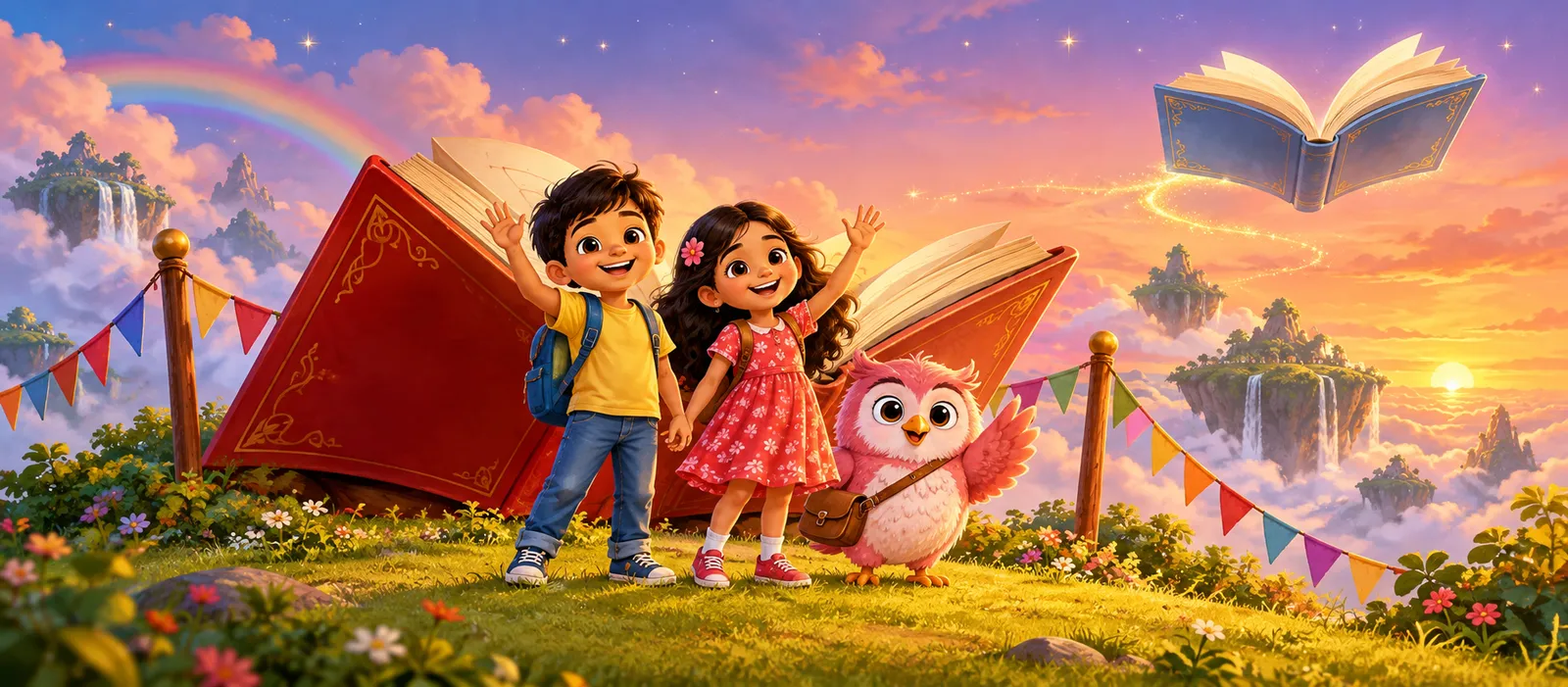
Whoosh! I am Piklu, and this is my flying book. Mira and Kabir are riding with me, high above the clouds. Down below are five islands, and on every one a game is waiting. Win it, and the sky turns sunny: off we fly to the next stop! Which island shall we visit first?
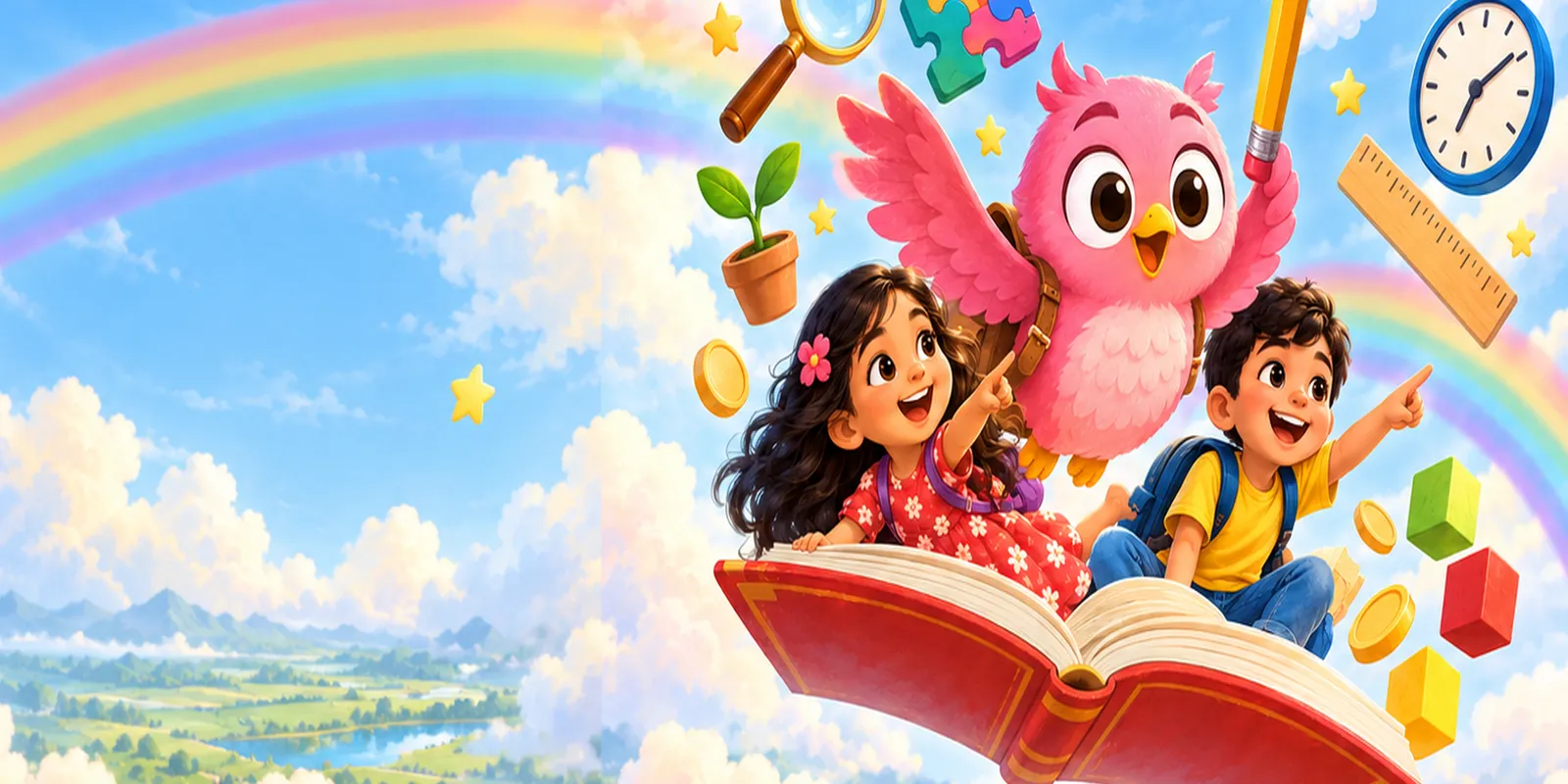
Grade 2 learning pathHold on tight: the flying book takes off!
For grown-ups For a child in Grade 2 (Class 2), about seven years old. Instead of picking any game at random, your child follows five paths, each in a few short stops, one step at a time. Each step is a free game at a set level: tap it and the game opens at that level. Read Piklu's lines aloud, and the flight does the rest.
A day's flight: 20 minutes, three boarding passes
Pass 1🎫
8 minutes
Words
The next step on Sounds and spelling or Reading and words, a different one each day.
Pass 2🎫
7 minutes
Thinking
The next step on Reasoning or Maths one day, and on Science and coding the next.
Pass 3🎫
5 minutes
Free pick
Any game your child likes. Keep this part: it is what makes them want to come back tomorrow.
Children are rarely even. Give a subject your child finds easy fewer days, and the one they find hard more. A child who is strong in maths can do a Maths step once or twice a week and spend the rest of the thinking time on Reasoning.
Check the weather: when to take the next step
- Sunny: fly on when most rounds earn ★★★, on two different days.
- Cloudy: stay while the stars are mixed. That is the right level: keep going.
- Stormy: go back a step when most rounds earn ★, or play stops being fun. The level was wrong, not your child.
The site saves nothing, so you keep track: print this page and tick each stop, or note the step numbers on your phone. Each path can move at its own pace. If the first steps are too hard, start with the Grade 1 learning path. A child who reaches the end of a path can fly on along the same path in the Grade 3 learning path.
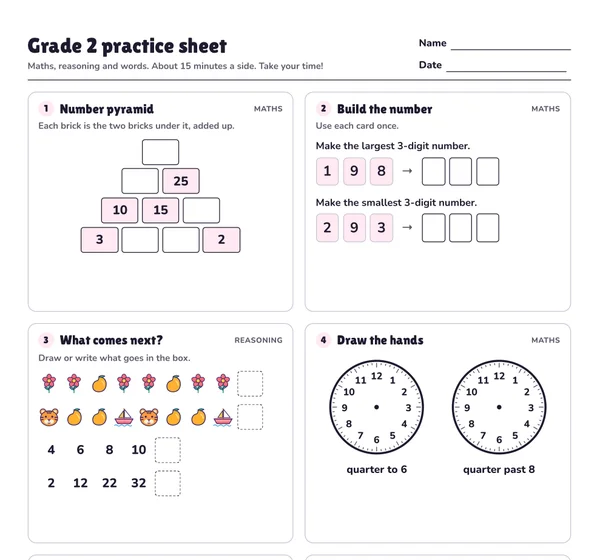
Print a practice sheet
A flight with no screen: one sheet of A4 to do with a pencil. Print it on both sides. The front has a number pyramid, building numbers, patterns, telling the time, a word ladder and a picture code; the back has coins, fractions, a tally, steering a rocket, a mini crossword and a number code. Each side takes about 15 minutes, so it can be two short sittings. The answers are printed upside down at the bottom of each side, for you.
⬇️ Download the practice sheet (PDF)
Would you like more sheets like this? Tell us on WhatsApp.
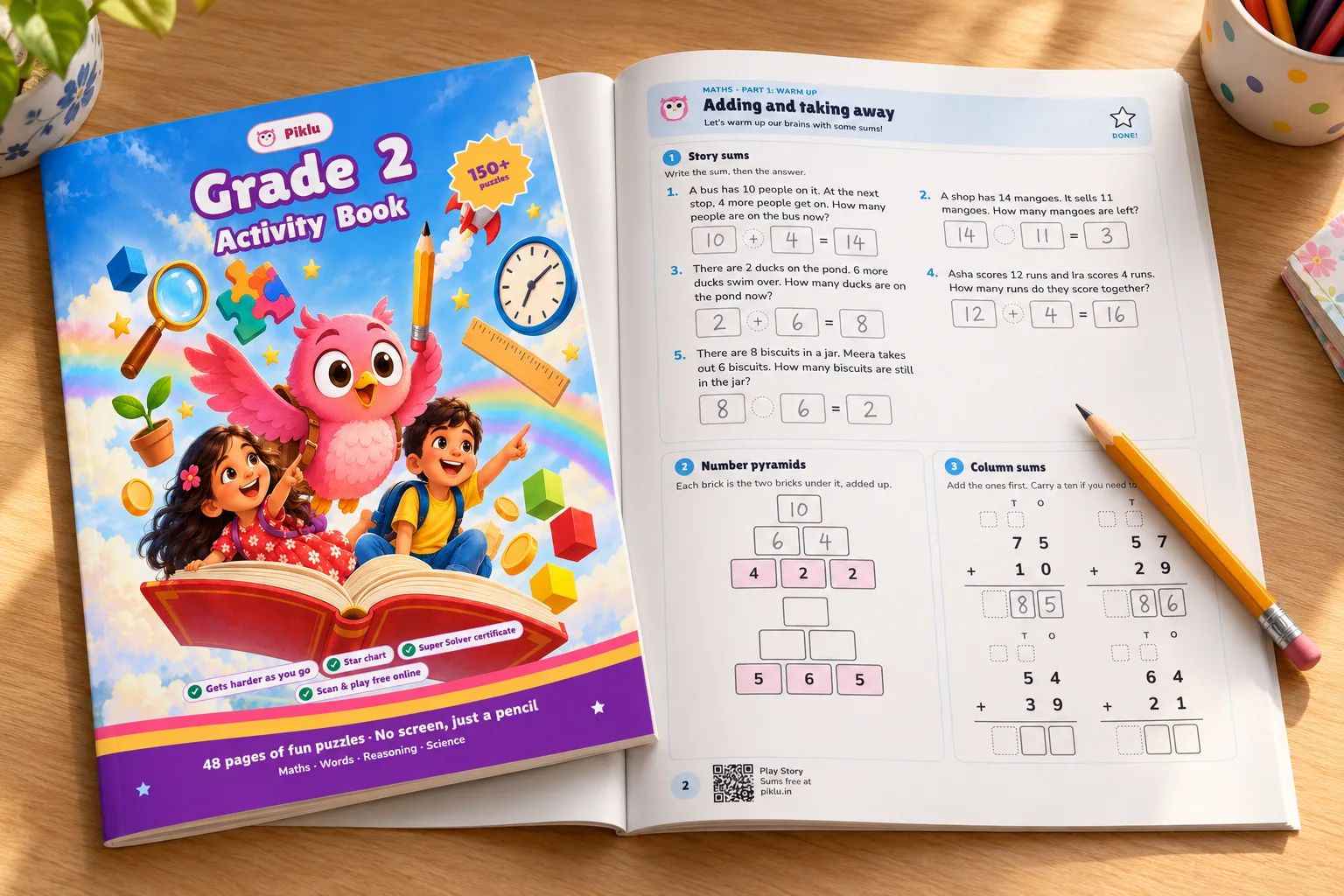
The Grade 2 activity book
The whole flight on paper, with Piklu's flying book on the cover. Its puzzles come from the games on this path, at Grade 2 levels, in four parts that get harder: Warm up, Keep going, Getting stronger and Super stretch. One page a day takes about 15 minutes, with just a pencil, and the code on every page opens its game here.
- 48 pages
- Over 150 puzzles
- A star chart
- A certificate at the end
Would you like one? Ask on WhatsApp, and we will tell you the price and the delivery.
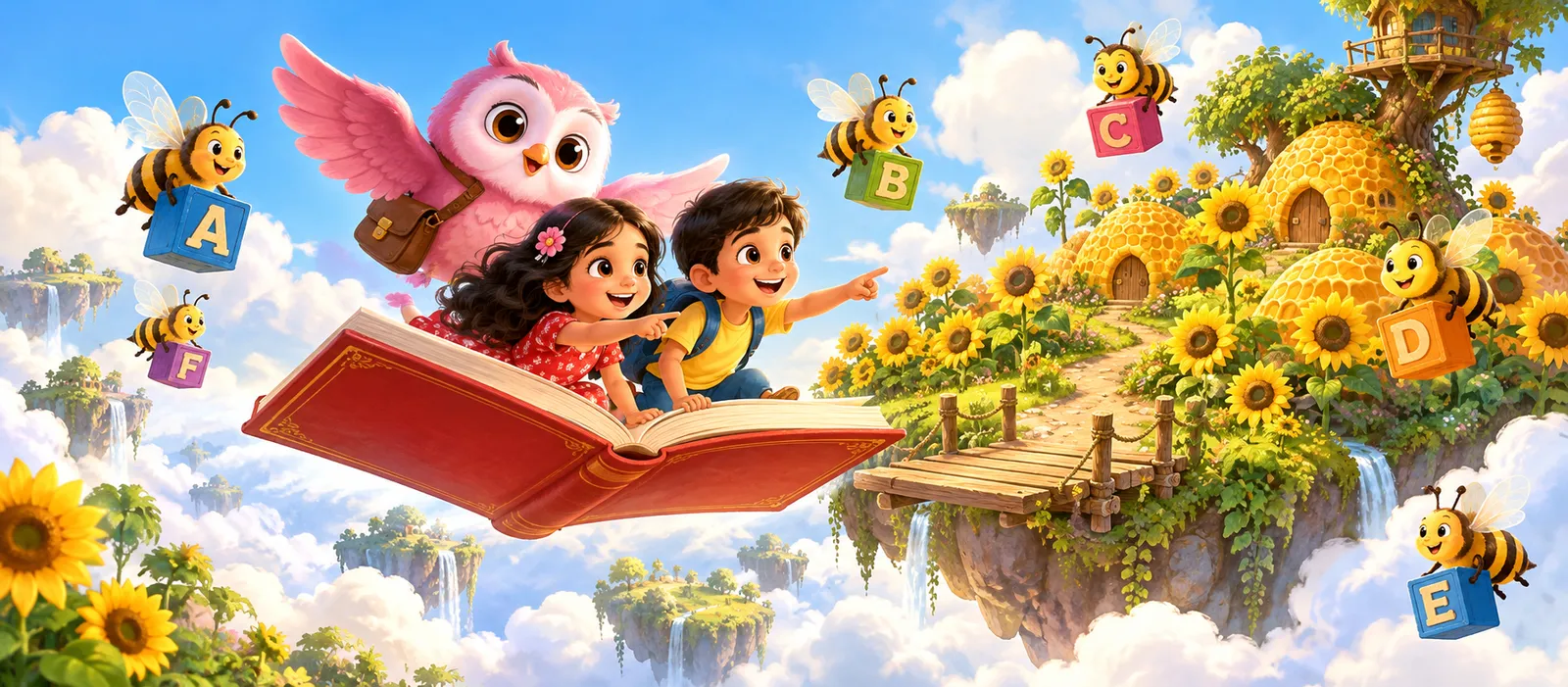
Island 1 · Next stopHoneycomb Island
Sounds and spelling
Listen closely! Every word is a string of sounds. Catch them all, and the letters that spell them.
Hearing the sounds in a word, then writing them down.
Sounds and short words
- Rhyme Time Medium Hear how a word ends, not only how it starts: cat rhymes with hat, not with car.
- Spell-a-Bee Easy Three-letter words: hear each sound, then spell the word.
- Word Ladder Easy Change one letter to make a new word, a sound at a time.
- Rhyme Time Expert One sound, two spellings: bear rhymes with chair.
Longer words and letter teams
- Spell-a-Bee Medium Longer words, of four and five letters.
- Word Ladder Medium A longer climb, five words from top to bottom.
- Spell-a-Bee Hard Letters that work in teams: sh, ch, th, bl.
One and many
- One and Many Easy One cat, two cats; one fox, two foxes: add s or es.
- One and Many Medium Words ending in y and f: baby to babies, leaf to leaves.
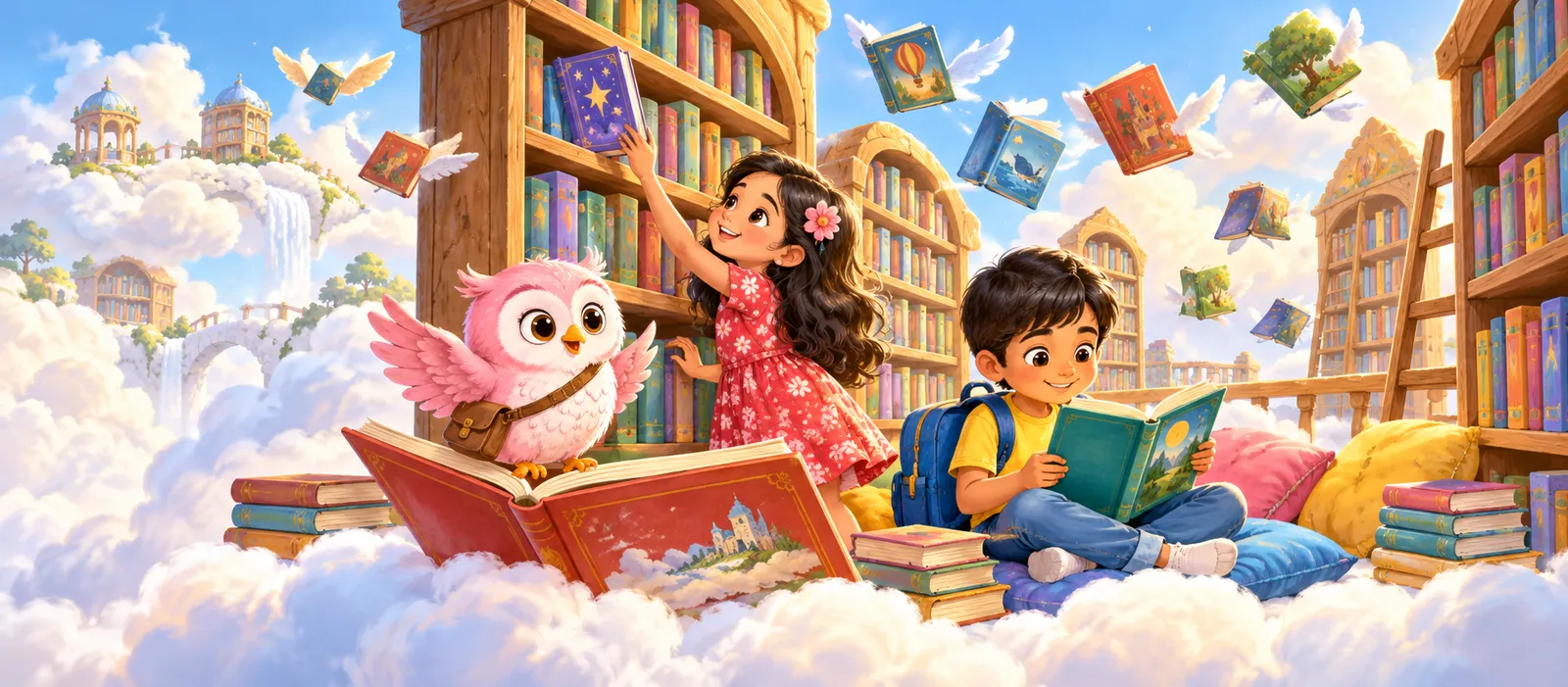
Island 2 · Next stopCloud Library
Reading and words
A library in the clouds, with words on every shelf. Let's read them and find out what they mean.
Reading for meaning, and the words that go with it.
Dictionary order
- ABC Order Easy Put words in order by their first letter.
- ABC Order Medium Order words that start the same, by their second letter, as a dictionary does.
Stories and riddles
- First, Next, Last Medium Four pictures to put in order.
- What Am I? Easy Read a short riddle about an animal or a food and work out what it is.
- Mini Crossword Easy Read a clue, then spell the word that answers it.
- What Am I? Medium Riddles about everyday things.
- First, Next, Last Hard How a butterfly, a frog or a bee grows, from the egg.
Sentences and grammar
- Sentence Train Medium Longer sentences to put in order, ending with a full stop or a question mark.
- Word Sorter Medium Special names need a capital letter. Find the special name, or the word you cannot count.
- Verb Time Machine Easy Read a sentence: did it happen yesterday, is it happening now, or will it happen?
Words that go together
- Word Pairs Easy Match each word to its opposite.
- Animal Words Medium Where animals live and the sounds they make, as words.
- Word Pairs Medium Match words that mean the same.
- Say What? Medium A pair of shoes, a loaf of bread: the words that go with each one. Do, make or take?
- Word Factory Medium More compound words, and no pictures to help.
- Say What? Hard One word for many: a person who writes books is an author.
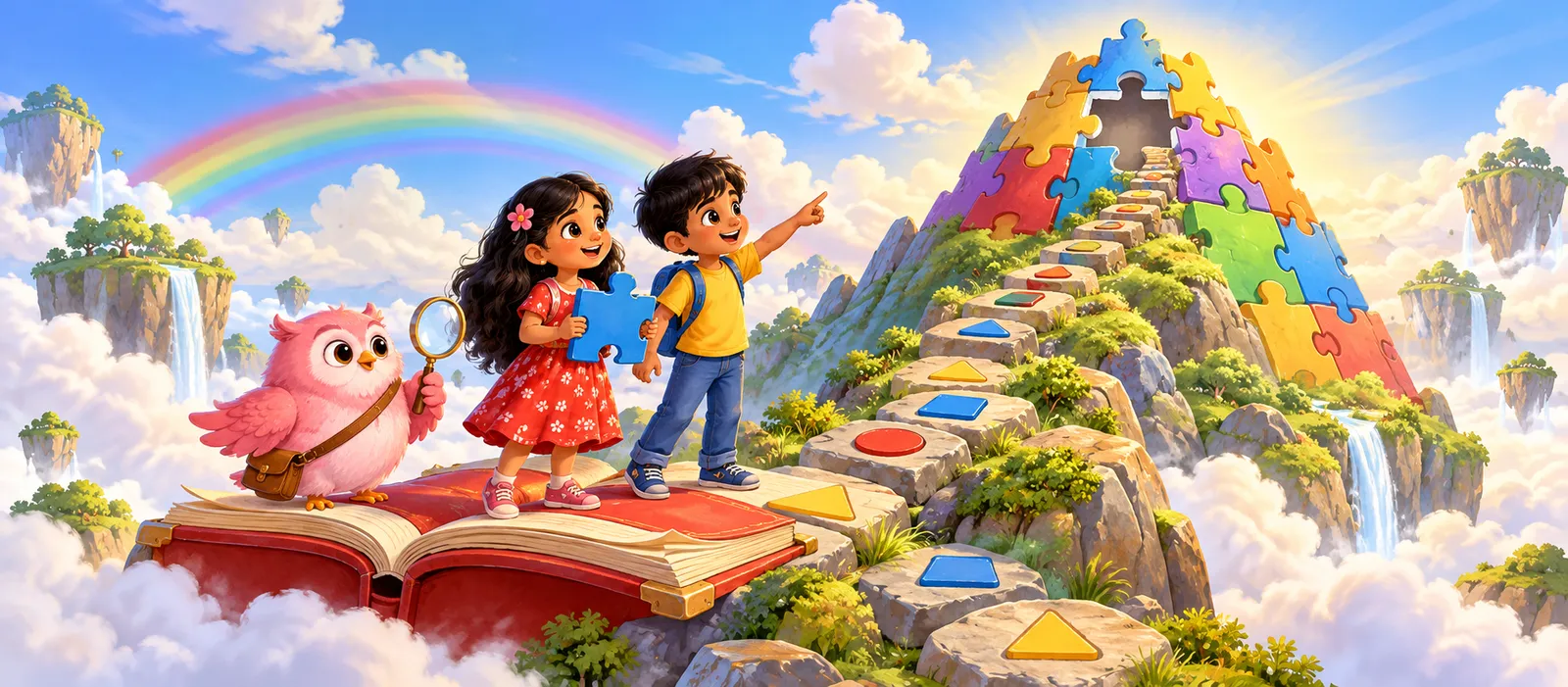
Island 3 · Next stopPuzzle Peak
Reasoning
Put on your thinking cap. What is the rule? What comes next? Look closely, then think a step ahead.
Spotting patterns, remembering, and thinking a step ahead.
Patterns and rules
- What Comes Next Medium Find the rule in a row of pictures and numbers, and say what comes next.
- Odd One Out Medium Find the odd one out when it is a close cousin, like a vegetable among fruits.
- Matrix Missing Easy A grid of pictures with one missing: one thing changes along each row.
- What Comes Next Hard Patterns that skip and double.
Order and position
- Queue Up Medium Four animals, and clues like “between” and “next to”.
- Word Sorter Hard Where is the cat? In, on, under, behind, in front of, next to or between.
- Alphabet Train Medium Deliver the parcel 3 after K, or 2 before G.
- Alphabet Train Hard The 7th letter, 4th from the end, and trains running backwards.
Shapes and space
- Mirror Draw Easy Finish the picture so both halves match.
- Seven Pieces Medium A quarter turn, a half turn or a three-quarter turn: which turn makes the piece fit?
- Seven Pieces Hard Turn three pieces and fit them into the shape.
- Cube Counter Medium Count every cube in a stack, even the ones you cannot see.
- Block Puzzle Medium More shapes and no single squares: look ahead before each block.
Clues, codes and memory
- Sneak Peek Easy Look for a few seconds, then remember what was there.
- Number Detective Medium Use the clues to rule numbers out until one is left.
- Secret Code Easy Crack a picture code to read the answer to a riddle.
- Matchstick Math Easy Move one matchstick to make the sum true.
- Matrix Missing Medium A grid of pictures where two things change at once. A stretch for most seven-year-olds.
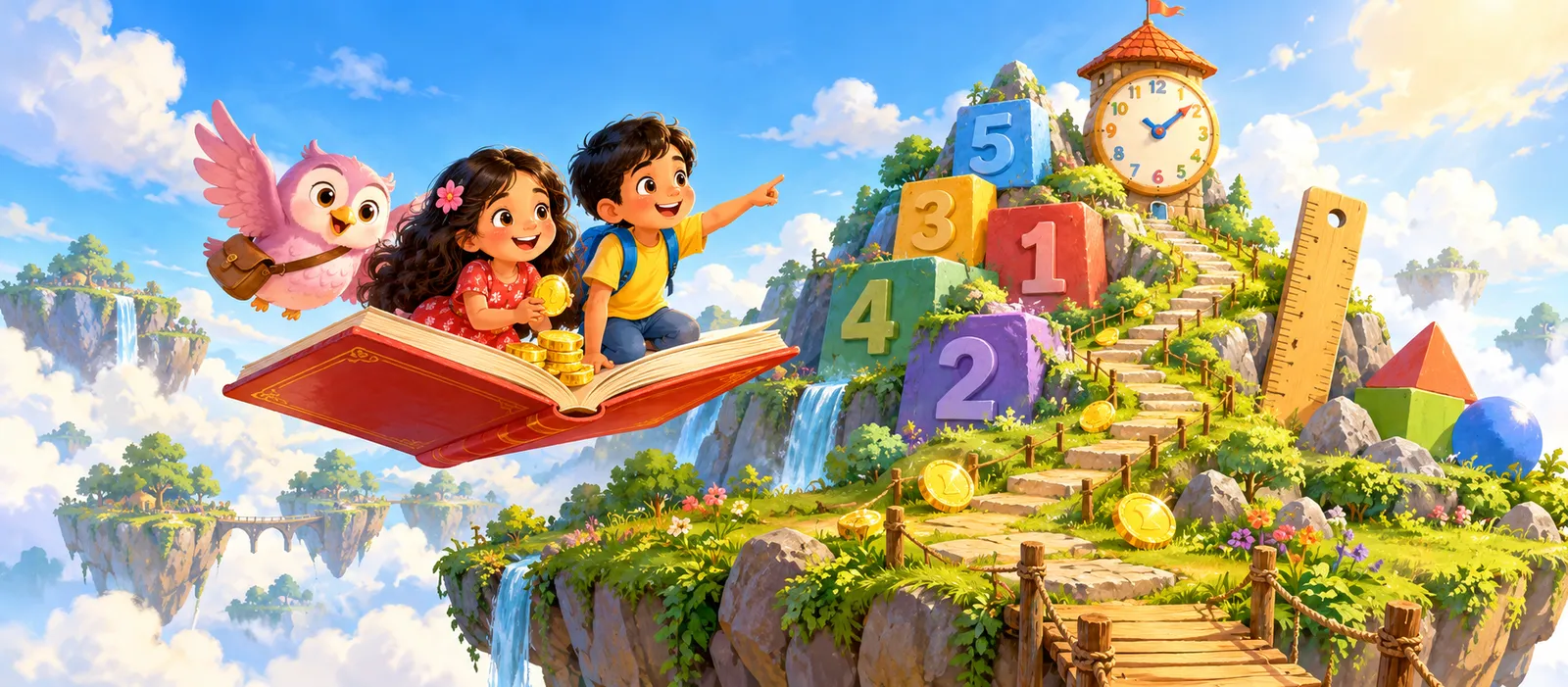
Island 4 · Next stopNumber Mountain
Maths
Big numbers, coins to count and clocks to read. Up the mountain we go, one number at a time!
Numbers to 1000, money, time, length, sharing and halves.
Numbers to 1,000
- Number Line Hop Medium 0 to 100 with a tick every 10: where do 70 and 35 live?
- Number Builder Medium Build three-digit numbers from hundreds, tens and ones.
- Number Line Hop Hard Only 0 and 100 are marked: find half way, then guess close.
Adding and taking away
- Math Monsters Medium Taking away, quickly and in the head.
- Number Pyramid Medium Every brick is the sum of the two below: add up, and take away to go down.
- Story Sums Medium Bigger numbers in stories, and “how many more?”.
- Column Carry Medium Take away in columns, and borrow a ten when the top digit is too small.
Money, time and measuring
- Coin Counter Medium Make an amount up to ₹50 with the fewest coins.
- Set the Clock Medium Half past and quarter past on a clock with hands.
- Measure Up Easy Read a ruler in centimetres.
- Kitchen Scales Medium Read a measuring jug in millilitres: work out what each small mark is worth. Off screen: Pour water into a measuring jug and read it.
- Coin Counter Hard Pay, then work out the change. A step into Grade 3.
Shapes and data
- Solid Shapes Medium Cube, cylinder, cone or sphere? Match a ball, a tin and a dice to their solid.
- Solid Shapes Hard Count the faces, edges and corners of a solid, even the hidden ones at the back.
- Tally & Chart Medium Count with tally marks, draw a chart, and read it.
- Outfit Maker Medium A photo table, a row for each shirt: 3 shirts × 2 shorts = 6.
- Outfit Maker Hard Caps too: 2 × 2 × 3 outfits, a table for each cap.
Sharing, halves and times tables
- Fair Share Easy Share cookies fairly between friends: the start of dividing.
- Pizza Party Easy Halves and quarters of a pizza.
- Math Monsters Hard Times tables from 2 to 9. A step into Grade 3.
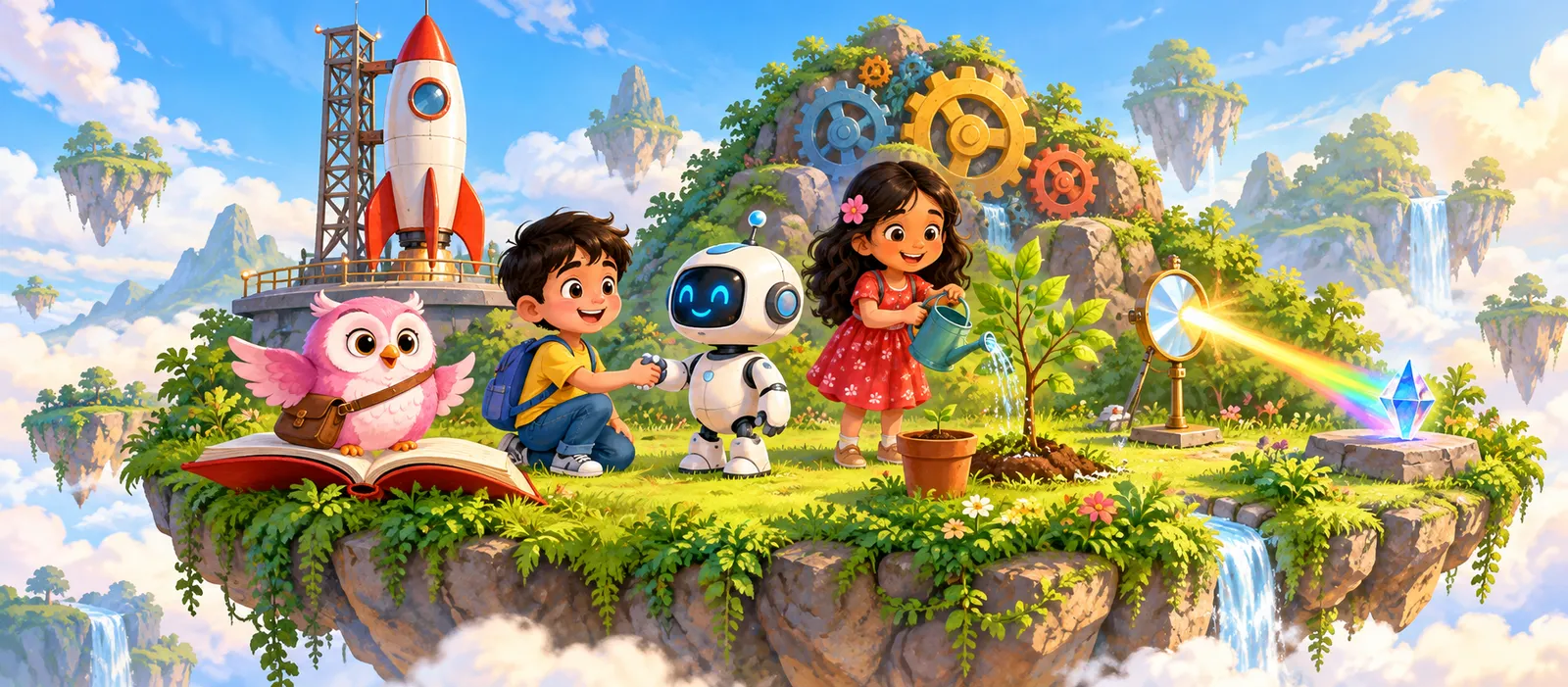
Island 5 · Next stopRocket Ridge
Science and coding
Plants and teeth, gears and robots, light and mirrors. Let's find out how the world works.
Sorting the world into groups, how living things depend on each other, and giving clear instructions.
Living things
- Sorting Lab Easy Living or not living? Off screen: Find three living and three non-living things at home.
- Seed to Tree Medium What does each part of a plant do? Roots soak up water, leaves make food.
- Seed to Tree Hard Which part of a plant do we eat? A carrot is a root, and a potato is a stem!
- Habitat Home Medium Match each animal to its home: desert, forest, ocean and more.
- Habitat Home Hard What a beak or a foot is for, and how birds build nests.
- Food Chain Easy Who eats who, starting from a plant.
- Food Chain Medium Chains of four, from a plant to a hunter.
Me and my world
- Healthy Me Medium Healthy teeth: incisors cut, canines tear, molars grind. And how germs spread. Off screen: Look in a mirror and find your incisors, canines and molars.
- Road Ready Medium Land, water or air? One person, or many people at once?
- Road Ready Hard What does this road sign mean? Is it an order, a warning or information?
- Bin It Medium Wet, dry or hazardous: old batteries and medicines are kept apart.
- Bin It Hard Reduce, reuse or recycle? Tell them apart from everyday actions.
How things work
- Sorting Lab Medium Will it float or sink? Off screen: Test a few of the answers in a bowl of water.
- Shadow Clock Medium A low sun makes a long shadow. Read the time from a shadow.
- Shadow Clock Hard The turning Earth: is it day or night at the red dot?
- Mirror Beam Easy Light travels in straight lines and bounces off a mirror. Off screen: Bounce a torch off a mirror in a dark room.
- Ramp Racer Medium Ice, wood, carpet or sand? Friction decides where the car stops.
- Ramp Racer Hard Change the ramp and the floor together to park the car.
- Gear Spin Easy Which way does each gear in a row turn?
Coding
- Robot Instructions Easy Steer a robot one step at a time, and watch it move.
- Robot Instructions Medium Write the whole program first, then press run. Every other robot has a bug to find and fix.
More games for this age
The free-pick shelf: every other Piklu game that suits a child of seven or eight, for pass 3 or for a change of scene. Each opens at the level to start with.
Numbers
Words
Puzzles
- Mouse Maze Medium
- Lights Out Medium
- Juice Jumble Medium
- Number Link Medium
- Water Pipes Medium
- Sun and Moon Easy
- Sudoku Easy
- Donut Tower Easy
Shapes & patterns
Beat the owl
- Tic Tac Toe Medium
- Connect Four Easy
- Crazy Eights
- Battleship Easy
- Last Berry Easy
- Chinese Checkers Easy
World & science
If reading or spelling is hard
- Read a real book together for 15 minutes every day. The games practise sounds and words; they do not replace reading.
- Go slowly on the two word paths. Two or three days on a step is normal. Starting below your child's age is fine, and the Grade 1 learning path has easier steps: winning is what keeps them trying.
- Leave Read aloud off in the word games, so your child reads the words, and switch it on only when they are stuck. Spell-a-Bee says each word, so it needs the sound on.
- Sit beside them for the first round of each new step and say the sounds together.
- If your child is a long way behind their class in both reading and spelling, ask the school or a reading specialist to check. Help works best when it starts early.
What this path does not cover
Piklu does not have games for everything a Grade 2 child learns, and we would rather say so:
- Reading a longer story and answering questions about it.
- Writing sentences, and handwriting.
- Odd and even numbers, skip counting, and writing numbers in words.
- Most of Grade 2 science beyond plants, food and teeth: the body, water and the weather. Those are best learned outdoors and in the kitchen.
Nothing on this page is tied to one school board or syllabus. It follows what most schools teach in Grade 2, and each step names exactly what it practises, so you can match it to your child's own books.
Coming in to land? Next flight: Grade 3
When a path is done, the same path carries on in the Grade 3 learning path.